
Carpal Tunnel Syndrome

Acupuncture for carpal tunnel syndrome in Denver gives desk-based professionals a non-drug, nonsurgical way to address wrist pain, tingling, and numbness, and it's backed by more than symptom tracking. A 2017 study published in Brain by Maeda and colleagues found that verum acupuncture measurably reduced nerve conduction latency and produced changes in the somatosensory cortex, the part of the brain that maps sensation from your hand. That's a different claim than "it feels better." It's evidence that the treatment reaches the nerve pathway itself.
This guide is for Denver office workers and desk professionals with numbness, tingling, or pain in the thumb, index, and middle fingers who want a realistic look at what acupuncture can and can't do, plus a clear plan for trying it. Before you start, confirm you have a diagnosed or suspected carpal tunnel syndrome (CTS) pattern rather than a different nerve or joint issue, and locate a Colorado-licensed acupuncturist near your office or home.
What's Actually Causing Your Symptoms
Carpal tunnel syndrome happens when the median nerve gets compressed as it passes through the carpal tunnel, a narrow passage in your wrist, according to a StatPearls clinical review. That compression produces pain, numbness, and tingling in the thumb, index, middle, and half of the ring finger. It's a mechanical problem first, which is why understanding the mechanism matters before you pick a treatment.
The symptom pattern has a signature: it's often worse at night and eases somewhat during the day, and shaking out your hands frequently brings temporary relief, according to InformedHealth.org. If that sounds familiar, you're likely dealing with classic CTS rather than general wrist strain.
Repetitive hand motion and high force intensity are the best-documented occupational risk factors. A 2022 systematic review and meta-analysis by Hassan and colleagues found repetitive motion carries a hazard ratio of 1.87 and high force intensity a hazard ratio of 1.84 for developing work-related CTS. Desk and computer work fits into this picture, but it's not the whole story: InformedHealth.org notes that any computer-work-specific effect on CTS risk appears minor on its own. Think of typing as one repetitive-strain input among several, alongside things like gripping a phone, driving, or manual tasks outside the office.
Left unaddressed, compression doesn't just stay uncomfortable. StatPearls warns that untreated CTS can progress to hand weakness, poor fine motor coordination, and eventually muscle atrophy. That progression risk is the real reason to act now instead of waiting it out.
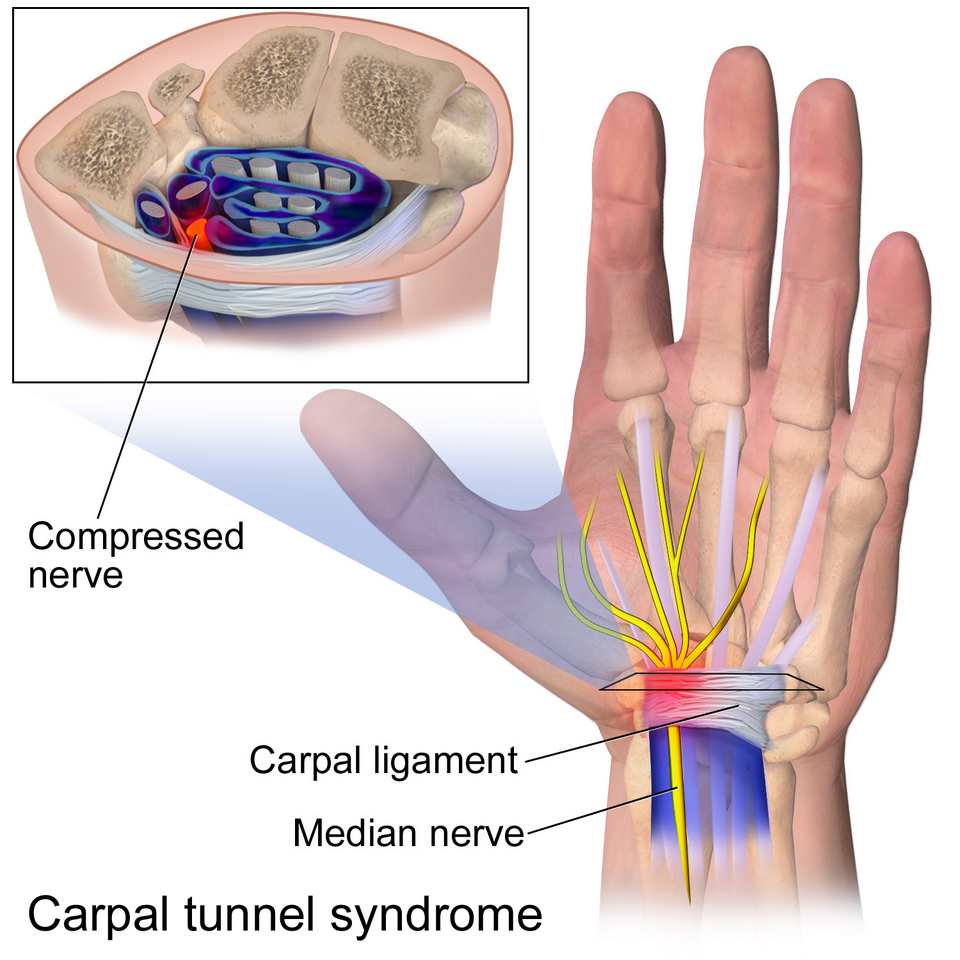
Carpal Tunnel Syndrome
Prerequisites Before Booking a Session
Before scheduling anything, gather what you need:
Confirm the symptom pattern. Numbness or tingling in the thumb through ring finger, especially at night, points toward CTS rather than a different nerve or joint condition.
Collect prior diagnostic notes. If you've had a nerve conduction study or a physician evaluation, bring those records so your acupuncturist can tailor treatment instead of starting from scratch.
Find a Colorado-licensed acupuncturist. Colorado requires a master's degree or doctorate in acupuncture plus a minimum of 2,500 hours of post-graduate training, according to Backupuncture of Denver's acupuncture service page. That licensure bar matters for a condition involving nerve physiology.
Identify a Denver-area clinic. Backupuncture of Denver, located at Cherry Tower (Humanly Space), 950 S Cherry St, Ste 1675, Denver, CO 80246, near Glendale and Cherry Creek, is one option for Denver professionals looking for orthopedic-focused acupuncture.
Step 1: Understand How Acupuncture Targets Nerve Compression & Inflammation
Learn the mechanism before your first visit so you know what the needling is actually meant to do. In the Maeda study, verum acupuncture significantly reduced median sensory nerve conduction latency (a 0.16-millisecond improvement, statistically significant at P = 0.01), while sham acupuncture showed no such change. Verum treatment also increased a brain-based marker called digit 2/3 cortical separation distance, essentially a sign that the somatosensory cortex was remapping how it processes signals from the hand. Patients whose cortical separation improved most were the ones whose symptom relief held up three months later.
Don't expect these neurological changes to eliminate structural compression by themselves. The researchers frame this as a contributing pathway, not a stand-alone cure.
Step 2: Choose the Right Type of Session for Your Case
Ask your practitioner whether treatment will use local points at the wrist, distal points elsewhere on the body, or both, and describe your symptom severity and how long you've had them. Backupuncture of Denver's proprietary Backupuncture® method combines distal acupuncture techniques with spinal analysis to address additional sources of nerve entrapment, which lines up directly with the nerve-compression mechanism behind CTS. Skipping this conversation risks a generic protocol that ignores your specific strain pattern, whether that's keyboard posture, phone gripping, or an old wrist injury.
Step 3: Know What Happens During a Typical Session
Arrive expecting fine, hairlike needles placed at local wrist points and/or distal points, such as on the opposite ankle. Electric stimulation (electroacupuncture) may be used on local or distal points, and both approaches are studied in clinical research. A 2023 systematic review by Dong and colleagues in Frontiers in Neuroscience, covering 16 randomized controlled trials, found common sets of points used across the majority of CTS protocols. Sessions typically run 20 to 30 minutes of needle retention; Backupuncture of Denver describes its standard sessions as under 37 minutes of face-to-face needling. Wear loose sleeves so your wrist is accessible.
Mild bruising or a brief increase in numbness can happen. One trial in the Dong review reported it in 6 of 30 patients, and it typically resolved within a week.
Step 4: Commit to a Realistic Course of Treatment
Plan for multiple sessions, not a single visit, and set your frequency based on your schedule and symptom severity. In the successful Maeda study, subjects received 16 acupuncture treatments over 8 weeks using a tapering schedule: three treatments per week for three weeks; two treatments per week for two weeks; and one treatment per week for three weeks; your acupuncturist will customize a plan that works with your schedule and budget. Stopping after one or two visits makes it hard to judge whether treatment is working, since the Maeda study found that durable improvement only became distinct from placebo at the three-month mark, though function and S1 brain mapping improved immediately upon completion of the course of acupuncture.
Step 5: Track Your Progress Against a Real Timeline
Log symptom changes weekly: numbness, nighttime waking, grip strength. A simple note comparing symptoms before and after each block of sessions is enough. In the Maeda study, both real and sham acupuncture reduced symptom severity immediately after therapy, with no meaningful difference between them (verum improved 21.3%, sham improved 22.7%). The real gap showed up at three months: verum acupuncture held its improvement at 25.1%, while the sham group's benefit faded to just 11.1% (a statistically significant difference). This is the insight most CTS acupuncture content misses: short-term relief tells you almost nothing about whether the treatment is actually working, because a placebo effect looks identical at first. The three-month mark is where the real signal appears.
Checkpoint: Are You on Track?
After your first 4 to 6 sessions, symptoms should trend down, even modestly. By three months, look for the pattern the Maeda study identified: sustained improvement rather than a fade-out. If nighttime numbness and daytime tingling haven't shifted at all by this point, revisit your treatment plan with your practitioner rather than continuing the same protocol unchanged.
Troubleshooting Common Issues
Symptoms improve then return. This mirrors the sham-group pattern from the Maeda study, where short-term gains faded by three months. Ask about adding distal point work or combining acupuncture with splinting. The Dong review found acupuncture plus splints outperformed splints alone for pain.
Mild soreness or bruising after sessions. This is expected per trial safety data and should clear within about a week. Mention it to your practitioner if it lingers. If the median nerve area itself feels sore from needling, ask your practitioner about shifting to distal-point-only electroacupuncture, which some protocols use to reduce local irritation while still targeting the nerve pathway.
Desk-work strain keeps recurring.Pair sessions with ergonomic changes at your workstation. Repetitive strain and high force intensity remain the best-evidenced occupational risk factors for CTS.
Book a Session Built Around Nerve & Alignment Care
Schedule a consultation with a Colorado-licensed acupuncturist experienced in orthopedic and nerve-related conditions. Ask specifically how the practice combines local and distal acupuncture points in its protocols. Bring the symptom log from Step 5 to your first visit so your practitioner can build a plan around your specific pattern from day one, not a generic protocol.