
Sports Acupuncture and Orthopedic Acupuncture: Focused Treatment for Healing and Performance
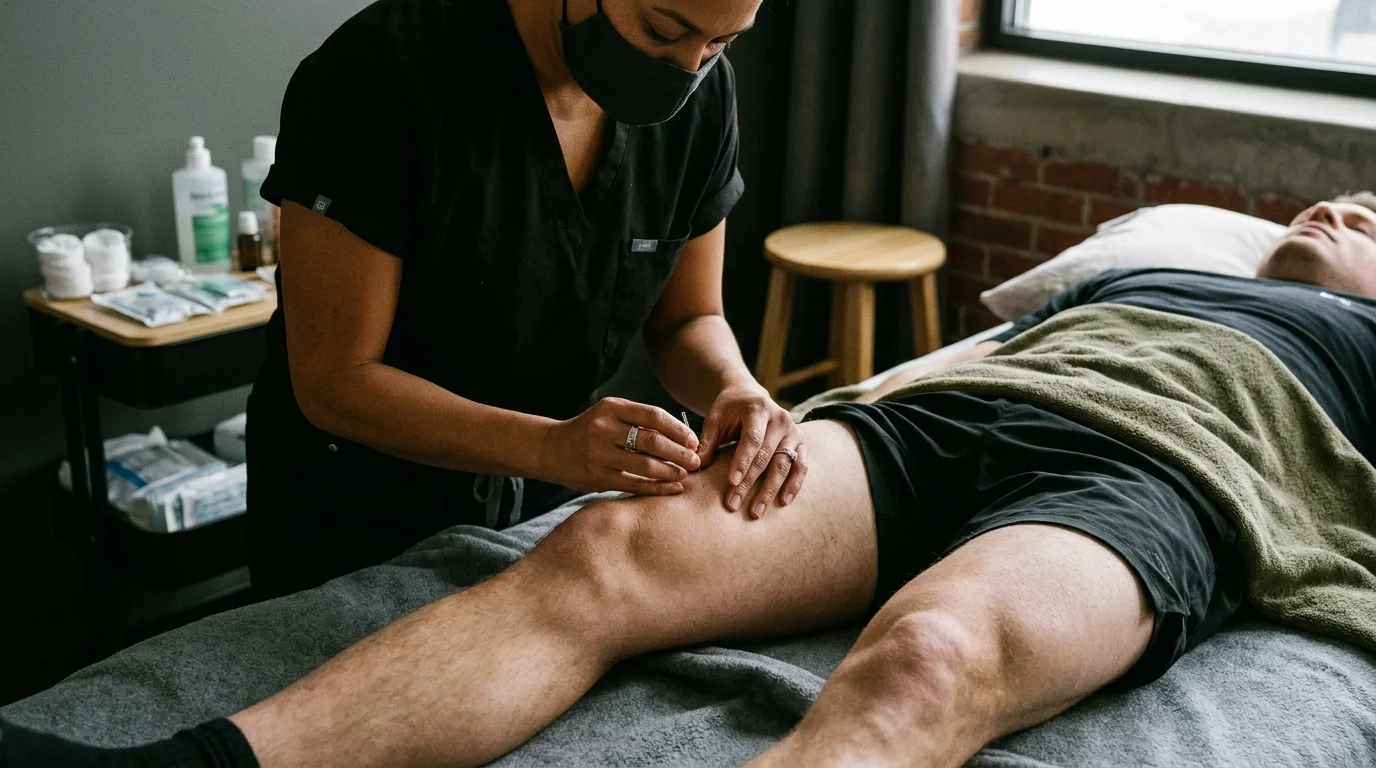
Denver sports acupuncture and Denver orthopedic acupuncture providers use targeted needling protocols, not generic relaxation sessions, to treat musculoskeletal injuries and spine pain. If you're an amateur or semi-professional athlete comparing clinics, the questions that matter are practical ones: What conditions does this provider actually treat? How fast can treatment fit into your return-to-play timeline? And does the practitioner have training beyond a base license?
What Sports and Orthopedic Acupuncture Actually Treat
Sports acupuncture and orthopedic acupuncture treat musculoskeletal pain and injury, not just general wellness complaints. Backupuncture's conditions list covers musculoskeletal pain, tendonitis and injuries of the neck, back, arms, legs, knees, shoulders, hands, feet—in other words, we treat the gamut of conditions commonly seen with sports acupuncture and orthopedic acupuncture: joint pain, soft-tissue injury, and chronic wear-and-tear pain, all treated with needling rather than medication or surgery.
The clinical philosophy behind orthopedic acupuncture is structural, not symptom-by-symptom. The focus is healing injuries and chronic pain through balancing the structure of the musculoskeletal system. That's the thinking behind Backupuncture®, our proprietary spinal alignment method that combines distal acupuncture techniques with spinal analysis to restore proper alignment, reduce nerve entrapment, and address the root causes of pain rather than just the sore spot. That means a knee problem might get treated with points that address hip or ankle alignment, not just the knee itself, along with points that reduce inflammation or reduce pain and stress activity in the brain to improve chronic muscle tension.
Sports acupuncture targets the specific injuries training and competition produce: tendonitis, joint strain, and soft-tissue damage that don't always show up clearly on imaging but limit performance daily. The goal across a course of treatment is pain relief, improved structural alignment, and faster tissue healing, so you're not just masking pain through a training block but actually shortening it.
This structural, whole-system approach is consistent with the research base on acupuncture for spine and musculoskeletal pain. A 2025 randomized clinical trial published in JAMA Network Open found that acupuncture produced meaningfully greater improvement in chronic low back pain-related disability than usual medical care alone, with a low-risk profile. A 2024 network meta-analysis in the Journal of Orthopaedic Surgery and Research, reviewing 27 randomized trials, found that several acupuncture-based methods outperformed routine care on pain relief and joint mobility for chronic low back pain, though it noted that functional-outcome evidence quality was lower and most trials were conducted outside the U.S. When you're evaluating a provider, that evidence supports asking whether the treatment plan addresses your injury within the surrounding structural chain, not just the isolated sore spot.
In Sports and Orthopedic Acupuncture, Training Matters
Beyond base licensure, additional orthopedic and sports-specific training exists in the field, including Sports Medicine Acupuncture Certification training that focus specifically on athletic injury patterns, joint mechanics, and return-to-play protocols. If you're comparing clinics, ask directly what additional certifications the treating practitioner holds and how they apply to your sport or injury pattern. A practitioner who's completed extra training beyond a base license is generally better positioned to build a plan around a running injury versus a throwing injury versus a lifting injury, since the mechanical stress patterns differ. Among our practitioners at Backupuncture of Denver, for example, we have many hours of training in Sports Medicine Acupuncture, orthopedic acupuncture, musculoskeletal acupuncture, orthopedic testing and structural assessment.
How Acupuncture and Dry Needling Fit Together
Dry needling and acupuncture use the same needle and often the same anatomical targets, but they come from different training traditions and toolkits. In Colorado, dry needling is already part of a licensed acupuncturist's scope of practice: "dry needling is in our scope of practice as acupuncturists in Colorado without any additional training." That matters because some providers market dry needling as a separate, specialized service when, for a licensed acupuncturist, it's one technique within a much larger set.
The overlap between the two approaches is well documented. A 2023 narrative review in Medical Acupuncture found a 93.3% anatomical correlation between 255 common myofascial trigger points and classical acupuncture points, and concluded that "the physiologic effects of acupuncture and DN are identical in musculoskeletal needling, despite the differences in language and the models used in acupuncture theory."
Where the two diverge is philosophy, not physiology. Dry needling, as typically taught, is exclusively aimed at deactivating myofascial trigger points through needling local muscle tissues. Acupuncture draws on a broader set of techniques that include not only local trigger point needling but non-local points that influence inflammation, tissue healing, global muscle tension, and activity in the pain and stress areas of the brain. Medical News Today notes that dry needling is a comparatively newer practice with a smaller evidence base, while "acupuncture currently has more support in research."
The practical takeaway for anyone comparing providers: a licensed acupuncturist with additional training in dry needling, orthopedic acupuncture, and Sports Medicine Acupuncture brings a wider set of tools to an injury than a provider certified in dry needling alone. That's a meaningful distinction to raise in a consultation call, not just a technicality.
Questions to Ask When Comparing Orthopedic Acupuncture Providers in Denver
Before booking with any provider, get clear answers to these:
Credentials: Does the practitioner hold a master's or doctorate in acupuncture plus 2,500-plus hours of post-graduate training, as Colorado licensure requires?
Specialization: Has the provider completed additional training in orthopedic acupuncture or Sports Medicine Acupuncture beyond base licensure?
Technique mix: Can the provider combine dry needling, distal point work, and spinal analysis in one treatment plan, or do they rely on a single technique?
Condition focus: Does the clinic explicitly treat your injury type, such as tendonitis, joint pain, herniated discs, or sciatica, rather than listing it as one entry among hundreds of general conditions?
Book a Sports or Orthopedic Acupuncture Evaluation in Denver
Faster, evidence-informed recovery starts with choosing a provider whose credentials and technique mix actually match your injury, not a one-size-fits-all session. The practitioners at Backupuncture of Denver, at 950 S Cherry St, Ste 1675, Denver, CO 80246, have specialized training and use sports medicine acupuncture, orthopedic acupuncture, and the Backupuncture® spinal alignment method to relieve pain, speed recovery of injuries, and improve performance. Book here or call 720.370.2711 to schedule an evaluation and get a treatment plan built around your specific injury, pain, or performance issue.